Welcome to WordPress. This is your first post. Edit or delete it, then start writing!
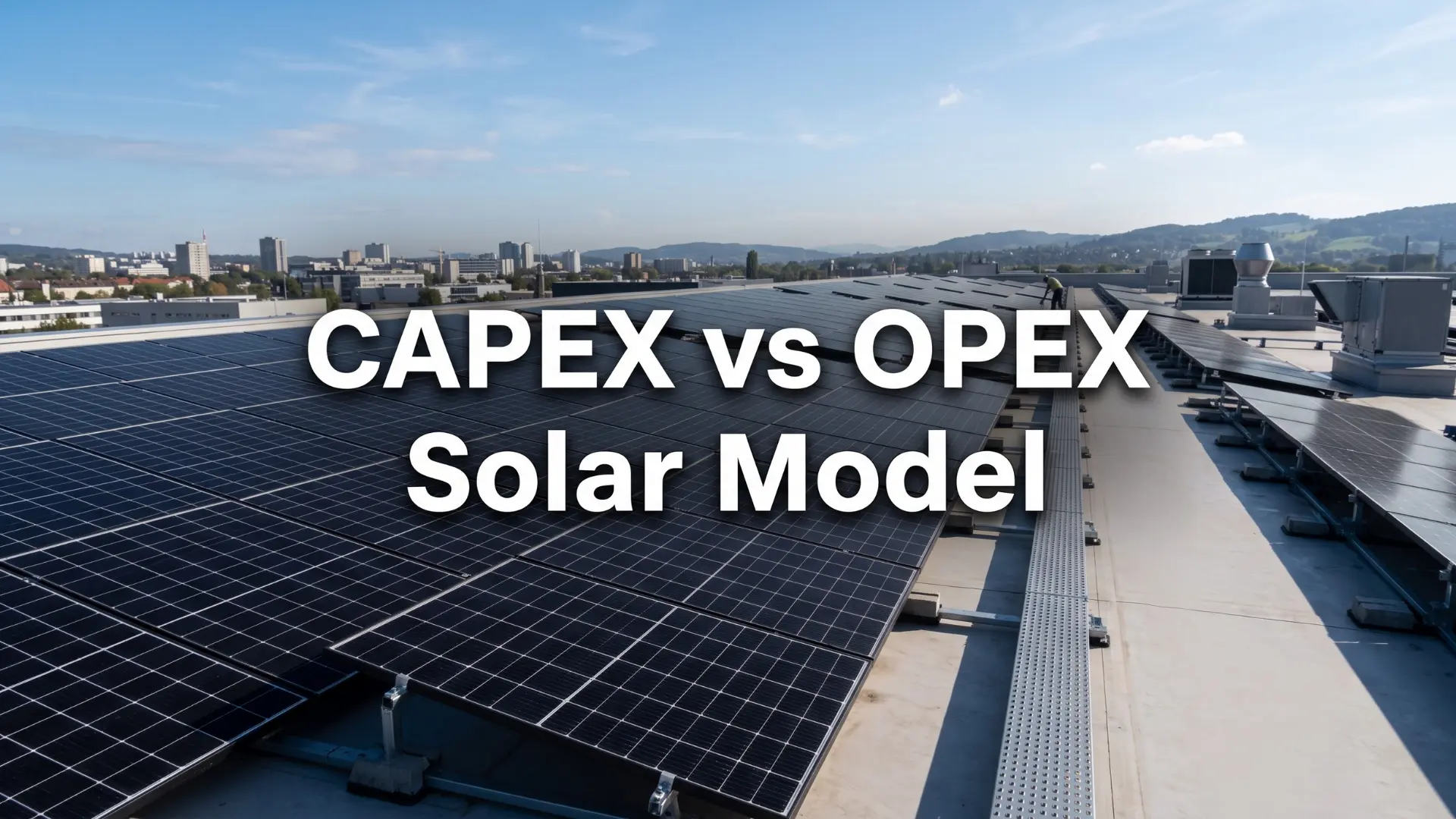
Installing a rooftop solar system can significantly reduce electricity costs for factories, warehouses, commercial buildings, and industrial facilities. However, one of the most important decisions is not the solar panel technology; it is the financing model.
Most industrial buyers compare two options before investing in solar:
Both models can help reduce electricity bills, but they work in very different ways. The right choice depends on your available capital, electricity consumption, financial goals, and long-term business plans.
In this guide, we will explain the difference between CAPEX and OPEX in simple language, compare their costs and benefits, and help you understand which model is generally better for industrial and commercial solar projects in Gujarat.
If you are already evaluating a rooftop solar project, you may also find our articles on Industrial Solar Rooftop Installation Cost in Gujarat and 1 MW Solar Plant Installation Cost in Gujarat useful, as they explain industrial project costs, ROI, and installation planning in detail.
For most industrial buyers, CAPEX typically yields greater long-term savings, while OPEX requires little or no upfront investment and is suitable for businesses that want to preserve working capital.
|
Factor |
CAPEX Model |
OPEX Model |
|
Ownership |
Industry owns the solar plant |
Third party owns the solar plant |
|
Initial Investment |
High |
Low or zero |
|
Electricity Savings |
Higher |
Moderate |
|
Long-Term ROI |
Higher |
Moderate |
|
Maintenance Responsibility |
Industry (or AMC provider) |
Solar provider |
|
Best For |
Businesses with available capital |
Businesses wanting zero upfront investment |
In simple terms:
In the CAPEX (Capital Expenditure) model, the business purchases and owns the solar power plant.
This means the company pays the installation cost upfront (or finances it through a loan) and becomes the owner of the entire solar system.
Suppose a factory installs a 1 MW rooftop solar plant.
Because of these advantages, many manufacturing companies and large industrial facilities in Gujarat prefer the CAPEX model when sufficient capital is available.
In the OPEX (Operating Expenditure) model, the industry does not own the solar plant.
Instead, a third-party investor or solar company installs, owns, operates, and maintains the system. The customer simply pays for the electricity generated by the solar plant under a Power Purchase Agreement (PPA).
This model is also commonly known as the RESCO (Renewable Energy Service Company) model.
A warehouse installs a rooftop solar plant through an OPEX agreement.
This model is attractive for businesses that want the benefits of solar power without making a large capital investment.
The best way to understand the difference is to compare the two models across the factors that matter most to industrial buyers.
CAPEX: The business pays the installation cost upfront or through financing.
OPEX: The business usually makes little or no upfront investment.
If preserving cash flow is a priority, OPEX has a clear advantage.
CAPEX: The solar plant becomes an asset owned by the business.
OPEX: The solar provider owns the system throughout the contract period.
Ownership is important because it affects long-term savings, depreciation, and asset value.
CAPEX: After installation, the cost of solar electricity is very low because the business owns the system.
OPEX: The business pays a tariff for every unit of electricity generated under the PPA agreement.
CAPEX: Usually provides significantly higher savings over the life of the plant.
OPEX: Provides savings compared with grid electricity, but a portion of the financial benefit goes to the system owner.
CAPEX: Typically around 3–6 years for many industrial projects, depending on electricity tariff and system performance.
OPEX: No traditional payback period because the customer does not make the capital investment.
CAPEX: The owner is responsible for maintenance, either internally or through an AMC provider.
OPEX: The solar provider handles operation and maintenance.
CAPEX: The solar plant appears as a business asset.
OPEX: No asset ownership is created.
CAPEX: Greater flexibility in upgrading, expanding, or modifying the system.
OPEX: Changes are generally governed by the contract terms.
For industries planning to operate at the same location for many years, CAPEX generally provides the highest lifetime financial return.
Consider a simplified example of a 1 MW rooftop solar plant.
After the payback period, most of the electricity generated continues to reduce the company’s electricity bill for many years.
Although OPEX reduces electricity costs from the first day, the total savings over the life of the plant are usually lower because the solar provider retains a portion of the financial benefit.
For many manufacturing industries, textile units, engineering plants, and large factories in Gujarat, the CAPEX model often becomes more profitable over the long term, especially when electricity consumption is high and the business intends to operate from the same facility for many years.
The CAPEX model is generally a better choice when a business is looking at solar as a long-term infrastructure investment rather than a short-term cost-saving option.
This model is often suitable for industries that:
For example, a manufacturing unit that operates continuously throughout the day and expects to remain at the same location for the next 15–20 years can often benefit significantly from owning its solar plant.
Many large industrial facilities in Gujarat choose the CAPEX model because it allows them to create a long-term energy asset while reducing exposure to future electricity tariff increases.
The OPEX model is often preferred when a business wants to adopt solar energy without making a major capital investment.
This model is generally suitable for:
An OPEX arrangement can be particularly useful when capital is better utilized for production expansion, machinery upgrades, inventory, or other core business activities.
For businesses that prioritize cash flow flexibility, OPEX can provide a practical way to start using solar energy immediately.
The most suitable model often depends on the type of industry and how the facility uses electricity.
|
Industry Type |
Generally More Suitable |
|
Textile Manufacturing |
CAPEX |
|
Engineering & Fabrication |
CAPEX |
|
Ceramic & Tiles |
CAPEX |
|
Pharmaceutical Manufacturing |
CAPEX / OPEX |
|
Food Processing |
CAPEX |
|
Warehousing & Logistics |
OPEX |
|
Commercial Buildings |
OPEX |
|
Multi-location Businesses |
OPEX |
For example, textile and engineering industries usually have high daytime electricity consumption, making ownership-based models more attractive. Warehousing and logistics businesses, on the other hand, often prioritize capital efficiency and operational flexibility.
The right choice should always be based on a site-specific financial and energy analysis, not only on industry type.
A Power Purchase Agreement (PPA) is the contract used in most OPEX solar projects.
Under a PPA:
The customer does not purchase the solar equipment. Instead, they purchase solar electricity.
Before signing a PPA, businesses should carefully review:
Understanding the PPA terms is important because the agreement governs the financial relationship between the business and the solar provider for many years.
The CAPEX and OPEX models are also treated differently from an accounting perspective.
A CAPEX solar plant is generally treated as a capital asset of the business.
Companies may evaluate:
An OPEX arrangement is generally treated as an operating expense, since the customer is paying for electricity or a solar service rather than purchasing the equipment.
Because tax treatment can vary depending on business structure, accounting standards, and applicable regulations, companies should consult their chartered accountant or tax advisor before making a final decision.
Both CAPEX and OPEX have advantages, but each also has potential risks that businesses should understand.
These risks can be reduced by selecting a reliable EPC company, using quality components, and implementing a proper maintenance program.
Businesses should carefully review contractual terms before entering a long-term OPEX agreement.
Gujarat has one of the strongest industrial solar markets in India, and both financing models are used across different sectors.
In practice:
The choice is usually driven by financial strategy, not by solar technology.
Companies with strong cash flow and long-term operational plans tend to favor ownership-based models, while businesses prioritizing capital efficiency often explore third-party financed solutions.
At Navi Energy, we understand that the best solar model is not the same for every business.
Before recommending a solution, we help industrial customers evaluate:
For businesses choosing the CAPEX model, we provide industrial rooftop solar EPC services, including system design, engineering, installation, testing, and commissioning.
For customers exploring financing options, we can help assess whether a CAPEX or OPEX structure is more suitable based on their operational and financial objectives.
If you are planning a large rooftop solar project, our guides on Industrial Solar EPC Company: How to Choose the Right Partner for Your Factory provide additional information about industrial project planning and investment evaluation.
What is the difference between CAPEX and OPEX in solar?
In a CAPEX model, the business owns the solar plant. In an OPEX model, a third party owns the plant and the customer pays for the electricity generated.
Which solar model is better for factories?
For factories with high electricity consumption and long-term operations, the CAPEX model is often more beneficial because it usually provides higher lifetime savings.
Is CAPEX cheaper than OPEX?
CAPEX requires a higher initial investment, but the cost of electricity over the life of the plant is usually lower than OPEX, resulting in greater long-term savings.
What is a solar PPA?
A Power Purchase Agreement (PPA) is a contract under which a business purchases electricity from a solar plant owned by a third-party provider.
Who maintains the solar system in the OPEX model?
The solar provider is generally responsible for operating and maintaining the system throughout the contract period.
Which model provides better ROI?
For businesses with available capital and long-term energy consumption, CAPEX generally provides a higher return on investment over the life of the solar plant.
Which model is suitable for a 1 MW rooftop solar plant?
Many industrial 1 MW rooftop projects are implemented under the CAPEX model because ownership often delivers stronger long-term financial benefits, although OPEX may be suitable for businesses prioritizing cash flow preservation.
There is no single financing model that is best for every industry. The right choice depends on capital availability, electricity consumption, financial priorities, and long-term business strategy.
If your goal is maximum long-term savings, asset ownership, and higher ROI, the CAPEX model is usually the stronger option.
If your goal is minimal upfront investment, predictable energy costs, and preserving working capital, the OPEX model can be a practical alternative.
For any industrial solar project, the most important step is a detailed technical and financial evaluation before selecting the financing model. A proper assessment can help determine which option will deliver the best value for your factory, warehouse, commercial building, or industrial facility in Gujarat over the next several decades.
306, Sunshine complex, Sudama chowk, Mota varacha., Surat, Gujarat 394101
Whether it’s your home or your business, it’s time to switch to clean and cost-saving solar energy. Our expert team provides hassle-free Solar installation across Gujarat, built for long-term savings and reliable power.